■問題PDF
令和7年度_学力検査問題過去問【大阪】- 英語C
令和7年度_学力検査問題過去問【大阪】- 英語C 解答
■目次
大問1
大問2
大問3
大問4
大問5
大問6
■大問1
Choose the phrase that best completes each sentence below.
1-1:Please tell ( ) help you.
ア I can do what to me
イ I can what to do me
ウ me do what to I can
エ me what I can do to
解答 : エ
解説 : tell (人) (what …)「(人)に(何が…か)を教える」という形です。”what I can do to help you”「私があなたを助けるために何ができるか」という節が続きます。
1-2:She was excited ( ) the national tournament.
ア the player who won to see
イ to see the player who won
ウ to the player who won see
エ won the player who see to
解答 : イ
解説 : be excited to (動詞)「~して興奮した」という不定詞の形です。”to see the player”「その選手を見て」となり、”who won…”「(大会で)勝った」が “player” を説明しています。
1-3:These broken things ( ) money.
ア can be repaired without much
イ can repaired without much be
ウ without much be repaired can
エ without repaired can be much
解答 : ア
解説 : 主語が “These broken things”(これらの壊れたモノ)なので、「修理される」という受け身(受動態) “can be repaired” を使います。”without much money”「あまり多くのお金なしに」が続きます。
1-4:I wonder ( ) to get here.
ア how many hours they kept walking
イ how walking they kept many hours
ウ many hours kept how they walking
エ many hours they kept walking how
解答 : ア
解説 : I wonder の後には「(彼らが)ここに着くまで*何時間*歩き続けたのか」という間接疑問文が続きます。”how many hours”「何時間」がカタマリとなり、”they kept walking”「彼らが歩き続けた」が続きます。
1-5: I ( ) on a bus.
ア get many bags a person holding helped
イ get a person helped many bags holding
ウ helped a person holding many bags get
エ helped many holding bags a person get
解答 : ウ
解説 : help (人) (get)「(人)が(乗る)のを手伝う」という形です。”a person holding many bags”「たくさんのカバンを持っていた人」が(人)の部分に当たります。
1-6:The website ( ) data for my research.
ア included various useful you recommended
イ you included various useful recommended
ウ you recommended included various useful
エ various useful recommended you included
解答 : ウ
解説 : The website が主語で、”(that) you recommended”「(あなたが)推薦した」が “website” を説明しています。”included”「を含んでいた」が動詞、”various useful data”「様々な役立つデータ」が目的語です。
■大問2
Read the passage and choose the answer which best completes each blank ① and ②, and choose the best answer to the question 3.
In 2023, a report was made on a survey to see what high school students think about changes in technology such as AI. The survey was done on high school students in four countries: Japan, America, China and Korea. In each country, more than 1,800 students joined the survey. It included many questions, and, for each question, the students were asked to choose one response from 4 choices: “definitely yes,” “somewhat yes,” “somewhat no” and “definitely no.” The following graphs show the percentages of the students who chose “definitely yes” or “somewhat yes” for two of the questions.
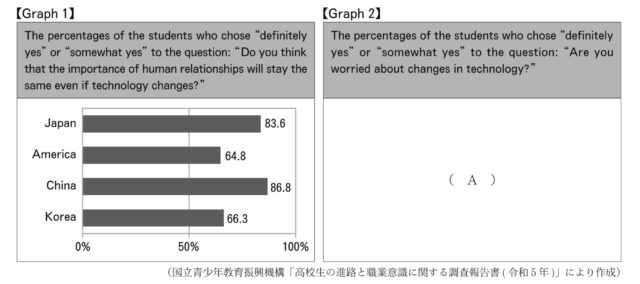
Graph 1 shows the results of the question: “Do you think that the importance of human relationships will stay the same even if technology changes?” To this question, [ ① ] in all of the four countries chose “definitely yes” or “somewhat yes.” Among the four countries, the percentage of the students who chose “definitely yes” or “somewhat yes” to the question was the highest in [ ② ] . Graph 2 shows the results of the question: “Are you worried about changes in technology?” The percentages of the students who chose “definitely yes” or “somewhat yes” to the question were between 50 percent and 60 percent in all of the four countries, and the percentage of the students who chose those two responses was lower in Japan than the percentages of the students who chose those two responses in America and Korea.
解説 : 2023年、AIのような技術の変化について高校生がどう考えているかを見るための調査に関するレポートが作られました。その調査は、日本、アメリカ、中国、韓国の4カ国の高校生に対して行われました。各国で、1,800人以上の生徒が調査に参加しました。それには多くの質問が含まれており、各質問に対し、生徒たちは「絶対にそう思う」「ややそう思う」「ややそう思わない」「絶対にそう思わない」の4つの選択肢から1つを選ぶよう求められました。以下のグラフは、2つの質問に対し「絶対にそう思う」または「ややそう思う」を選んだ生徒の割合(パーセンテージ)を示しています。
グラフ1は、「技術が変化しても、人間関係の重要性は変わらないと思いますか?」という質問の結果を示しています。この質問に対しては、4カ国すべてにおいて [ ① ] が「絶対にそう思う」または「ややそう思う」を選びました。4カ国のうち、その質問に「絶対にそう思う」または「ややそう思う」を選んだ生徒の割合は、[ ② ] が最も高かったです。グラフ2は、「技術の変化について心配していますか?」という質問の結果を示しています。その質問に「絶対にそう思う」または「ややそう思う」を選んだ生徒の割合は、4カ国すべてにおいて50パーセントから60パーセントの間でした。そして、日本においてそれら2つの回答を選んだ生徒の割合は、アメリカと韓国におけるその割合よりも低かったです。
2-1:ア less than half of the students
イ 83.6 percent of the students
ウ only a quarter of the students
エ more than 60 percent of the students
解答 : エ
解説 : Graph 1 を見ると、4カ国(Japan, America, China, Korea)の生徒の割合は、すべて60%を超えています。
2-2:②ア Japan イ America ウ China エ Korea
解答 : ウ
解説 : Graph 1 で、”definitely yes” または “somewhat yes” と答えた生徒の割合が最も高いのは、86.8% の China です。
2-3:Which graph should be put in ( A )?
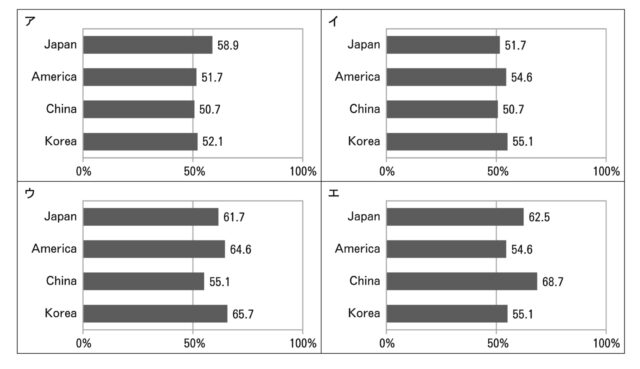
解答 : イ
解説 : 本文の Graph 2 の説明に「4カ国すべてで50%から60%の間」であり、「日本はアメリカと韓国よりも割合が低かった」とあります。これに該当するのは、Japan (51.7) が America (54.6) と Korea (55.1) より低く、全数値が50-60の間である「Graph イ」だけです。
■大問3
Read the passage and choose the answer which best completes each sentence 1~5.
There are various products made of cork around us such as cork stoppers and cork boards. For thousands of years, people have used cork for making various things because cork is light and doesn’t easily let water go through. In the 18th century, as more glass bottles were used, more cork was used for making stoppers of the bottles. These days, cork is often recycled. Recycled cork is used for walls of buildings because walls using cork don’t easily let heat go through. Even if the temperature outside becomes very high, the temperature in a room with walls using cork isn’t affected a lot. Many people know that cork is ( 1 ) material because it can be recycled, and now it is getting attention for more reasons.
Cork comes from the bark of cork oak trees. These trees grow in forests in a part of Europe and a part of Africa. You may think that, when people harvest the bark, they cut down the trees.
However, the bark can be harvested without doing so. After the bark is harvested, new bark is made. People can harvest the bark of one cork oak tree about 15 to 18 times while the tree is living, and cork oak trees live for about 200 years. For these many years, cork oak trees can be a good home for various animals including some endangered birds and can support the diversity of species in forests. Also, when cork oak trees make new bark, the amount of carbon dioxide they take in from the air greatly increases. That means the trees ( 2 ) .
Now, many companies pay attention to this eco-friendly material and its excellent features, and they use it to make even some parts of space ships.
解説 : 私たちの周りには、コルク栓やコルクボードなど、コルクでできた様々な製品があります。コルクは軽く、水を容易に通さないため、何千年もの間、人々は様々なものを作るためにコルクを使用してきました。18世紀には、より多くのガラス瓶が使われるようになるにつれて、瓶の栓を作るためにより多くのコルクが使われました。最近では、コルクはしばしばリサイクルされます。リサイクルされたコルクは、コルクを使った壁は熱を容易に通さないため、建物の壁に使われます。外の気温が非常に高くなったとしても、コルクを使った壁の部屋の室温はあまり影響を受けません。多くの人々は、コルクがリサイクルできるために ( 1 )素材であることを知っており、そして今、それはさらに多くの理由で注目を集めています。
コルクはコルクガシの木の樹皮から採れます。これらの木は、ヨーロッパの一部とアフリカの一部の森林で育ちます。人々が樹皮を収穫するとき、木を切り倒すと思うかもしれません。しかし、樹皮はそうすることなく(=木を切り倒さずに)収穫することができます。樹皮が収穫された後、新しい樹皮が作られます。コルクガシの木は約200年生き、人々は1本のコルクガシの木が生きている間に、その樹皮を約15回から18回収穫することができます。この長い年月の間、コルクガシの木は、絶滅の危機に瀕している鳥類を含む様々な動物にとって良いすみかとなり、森林の種の多様性を支えることができます。また、コルクガシの木が新しい樹皮を作るとき、それらが空気中から取り込む二酸化炭素の量は大幅に増加します。それは、その木が ( 2 )ことを意味します。
現在、多くの企業がこの環境に優しい素材とその優れた特徴に注目しており、宇宙船の部品の一部を作るためにさえそれを使用しています。
3-1:The temperature in a room with walls using cork
ア is easily influenced by the temperature outside.
イ doesn’t change a lot even if it gets very hot outside.
ウ is always high because walls using cork let heat go into the room.
エ is always low because walls using cork let heat go out of the room.
解答 : イ
解説 : 本文に、コルクを使った壁がある部屋の室温は「外の気温が非常に高くなっても、あまり影響を受けない (isn’t affected a lot)」とあります。
3-2:The word which should be put in ( ① ) is
ア medical
イ narrow
ウ social
エ sustainable
解答 : エ
解説 : リサイクル可能であり、樹皮を採取しても木を伐採せず、木が長生きする ことから、コルクは「持続可能な (sustainable)」素材と言えます。
3-3:People can harvest the bark of a cork oak tree
ア by cutting down the tree.
イ without cutting down the tree.
ウ about 15 to 18 times every year.
エ 200 times while the tree is living.
解答 : イ
解説 : 本文に、樹皮は「そうすることなしに(=木を切り倒すことなしに)採取できる」とあります。
3-4:The phrase which should be put in ( ② ) is
ア always take in the same amount of carbon dioxide from the air.
イ are helpful in reducing the amount of carbon dioxide in the air.
ウ have no chance to take in carbon dioxide from the air.
エ play a major role in increasing the amount of carbon dioxide in the air.
解答 : イ
解説 : 本文に、コルク樫の木が新しい樹皮を作るとき、「空気中から取り入れる二酸化炭素の量が大幅に増加する」とあります。これは「空気中の二酸化炭素の量を減らすのに役立つ」ことと同じです。
3-5:According to the passage,
ア people first started to use cork to make things in the 18th century.
イ cork houses built for endangered animals are supporting their lives.
ウ cork is the bark of a specific kind of tree which can be seen in a part of Europe and a part of Africa.
エ many companies have started using other materials instead of cork to protect the environment.
解答 : ウ
解説 : 本文に、コルクは「コルク樫の木の樹皮 (bark of cork oak trees)」であり、これらの木は「ヨーロッパの一部とアフリカの一部 (a part of Europe and a part of Africa)」で育つとあります。
■大問4
Read the passage and choose the answer which best completes each sentence 1~5.
Many people may not know what “Kazusabori” is. It is a method for digging a deep well safely. The method was developed in the Kazusa area in Japan in the late 19th century. In the area, it was difficult to get water from rivers, so people dug wells. Each well had to be deep enough to reach water under the ground. At first, people dug a well by working inside a hole. However, that way was dangerous. Also, they couldn’t dig a deep well in that way. So, they tried many different ways. And finally they were successful in digging a deep well safely by using some tools they created. [A] The long stick was made of bamboo and it had an iron part at the bottom. By moving the long stick outside the hole, people broke rocks in the hole without working inside. [B] As the hole became deeper, they made the stick longer. [C] Another tool was created to move the long stick without using much power. [D] They also created a tool which helped them remove broken pieces of rocks out of the hole. With these tools, people could safely dig a well which was a few hundred meters deep. People used not only bamboo but also other materials around them to make these tools. The method of digging a well with these tools was [ ① ] to many areas in Japan. People in those areas started to call the method Kazusabori and used it until people there started to use machines.
About one century later, Kazusabori was introduced in some areas in the world as a method for digging a well without using a machine. In those areas, some people had to walk to a river to get water and then walk back with heavy water. In 1981, people started to dig wells with Kazusabori in one Asian country. Wells completed in some schools helped children get water easily. Later, Kazusabori was introduced in one country in Africa, too. However, people there couldn’t get bamboo. So, they used the idea of Kazusabori and made similar tools for digging a well by using things they could easily get there. Finally, they completed some wells by using these tools. The number of wells in Asia and Africa increased little by little, and now more people are able to get water easily.
There are still serious water problems in the world. Kazusabori is helping people solve them.
4-1: People in the Kazusa area tried many different ways to ア dig a deep well safely. イ dig wells all over Japan. ウ find a safe way for working in rivers. エ go to rivers.
解答 : ア
解説 : 本文に、人々は多くの異なる方法を試し、「最終的に…安全に深い井戸を掘ることに成功した」とあります。
4-2:The sentence “One of them was a long stick used to make a deep hole.” should be put in
ア A
イ B
ウ C
エ D
解答 : ア
解説 : 直前の文で「彼らが作ったいくつかの道具 (some tools they created)」について述べられています。挿入する文は「*それらの一つが*長い棒だった (One of them was a long stick…)」であり、[A] の直後には「*その*長い棒は… (The long stick…)」と続いているため、[A] が最適です。
4-3:The word which should be put in ( ① ) is
ア joined.
イ returned.
ウ spread.
エ worn.
解答 : ウ
解説 : 「(上総掘りの)方法は日本の多くの地域へ( ③ )」という文脈であり、「広まった (spread)」が適切です。
4-4:The phrase these tools refers to
ア the tools made of bamboo.
イ the tools made in the Kazusa area.
ウ the tools people in an Asian country made without using the idea of Kazusabori.
エ the tools people in a country in Africa made with things they could easily get there.
解答 : エ
解説 : 直前の文で、アフリカの国の人々が「そこで簡単に入手できるものを使って (with things they could easily get there)」道具を作ったと述べられており、”these tools” はそれらの道具を指しています。
4-5:According to the passage,
ア people in the Kazusa area used only bamboo to make all the tools for digging a well.
イ Kazusabori was introduced in some areas in the world in the late 19th century.
ウ people in one Asian country couldn’t start to dig wells in 1981 because they didn’t have machines for digging a well.
エ thanks to Kazusabori, people in some areas in the world can get water easily.
解答 : エ
解説 : 本文の最後に「(上総掘りのおかげで)今ではより多くの人々が簡単に水を得ることができている」とあります。
■大問5
Read the passage and choose the answer which best completes each sentence 1, 2, 4, 5 and 6, and choose the answer to the question 3.
Today, if people visit a planetarium, they can learn the positions and movements of celestial bodies. Many planetariums today show those things with machines using high technology. This type of modern planetarium was born in Germany at the beginning of the 20th century. [ ① ] that type of modern planetarium was made, in the late 18th century, a man in the Netherlands tried to show the positions and movements of celestial bodies in a different way. The man’s name is Eise Eisinga. After graduating from elementary school, he didn’t continue to study in school, but he kept studying math and science by himself. He was especially interested in celestial bodies.
In 1774, when he was 30 years old, a special phenomenon was seen in the sky. On May 8th, 1774, four planets and the moon were seen close together in the eastern sky at the same time. A local newspaper in the Netherlands said that the earth would be greatly damaged because of this phenomenon. When people read the newspaper, many of them believed that the things written in the newspaper were [ ② ] so they worried about the earth and their lives very much. Now, many people know that this type of phenomenon doesn’t cause any trouble to the earth or people’s lives. However, the situation was different in 1774. In those days, only a few people including Eise Eisinga had enough information on the positions and movements of the celestial bodies to understand that the phenomenon would not affect the earth. On the other hand, many other people at the time didn’t have such information. [ ③ ] He thought people could learn about celestial bodies with the system.
He tried many ideas and created a system to show the positions and movements of the sun and some planets. It was a system which he put on the ceiling of a room in his house. Round objects were used to show the celestial bodies. The system including those round objects was moved by only one pendulum clock set in the attic above the room. With this system, people could easily see how the celestial bodies moved by looking up. The system was not simple and he needed many things such as gears and pulleys to complete the system. Surprisingly, he made most parts for the system by himself. He even made thousands of nails used for the system. The system was designed very well. When he almost finished creating the system, some scientists visited his house to see it. They were surprised to find the system was designed very well to show the positions and movements of the celestial bodies clearly. [ ④ ] Like this, before it was completed, and they were looking forward to seeing the completed system.
After seven years of hard work, he finally completed his system and called the room with the system a “planetarium.” He let people come inside and see his planetarium. His planetarium became very popular, and not only his neighbors but also people who lived far away came to see it. His hope of sharing his information about celestial bodies with others resulted in creating his planetarium to show the latest information about celestial bodies at the time. Though his planetarium was quite different from many of today’s planetariums which use high technology to show celestial bodies, his planetarium played an important role to help people understand better about celestial bodies. Eise Eisinga’s planetarium still works and accepts visitors from all over the world.
解説 : 今日、もし人々がプラネタリウムを訪れれば、天体の位置や動きを学ぶことができます。今日の多くのプラネタリウムは、高い技術を使った機械でそれらのことを映し出します。このタイプの近代的なプラネタリウムは、20世紀初頭にドイツで誕生しました。1 そのタイプの近代的なプラネタリウムが作られる[ ① ]、18世紀後半、オランダのある男性が、異なる方法で天体の位置や動きを示そうとしました。その男性の名前はアイゼ・アイジンガです。小学校を卒業した後、彼は学校で勉強を続けませんでしたが、独学で数学や科学を勉強し続けました。彼は特に天体に興味がありました。
1774年、彼が30歳のとき、空に特別な現象が見られました。1774年5月8日、4つの惑星と月が同時に東の空で接近して見えたのです。オランダのある地元新聞が、この現象のために地球は大きな損害を受けるだろうと報じました。人々がその新聞を読むと、彼らの多くはその新聞に書かれていることは [ ② ]と信じ、そのため地球や自分たちの生活について非常に心配しました。今では、多くの人々がこの種の現象は地球や人々の生活に何の問題も引き起こさないことを知っています。しかし、1774年当時は状況が異なっていました。その頃は、アイゼ・アイジンガを含むほんの少数の人々だけが、その現象が地球に影響を与えないことを理解するのに十分な天体の位置や動きに関する情報を持っていました。一方、当時の他の多くの人々はそのような情報を持っていませんでした。[ ③ ]彼は、人々がそのシステムで天体について学べると考えたのです。
彼は多くのアイデアを試し、太陽といくつかの惑星の位置や動きを示すシステムを作り出しました。それは、彼が自宅の部屋の天井に設置したシステムでした。天体を示すために丸い物体が使われました。それらの丸い物体を含むシステムは、部屋の上の屋根裏部屋に設置されたたった一つの振り子時計によって動かされていました。このシステムによって、人々は見上げるだけで天体がどのように動くかを簡単に見ることができました。そのシステムは単純ではなく、彼がシステムを完成させるためには歯車や滑車のような多くのものが必要でした。驚くべきことに、彼はそのシステムの部品のほとんどを自分で作りました。彼はシステムに使われる何千本もの釘さえも作りました。そのシステムは非常によく設計されていました。彼がシステムの製作をほぼ終えたとき、何人かの科学者がそれを見るために彼の家を訪れました。彼らは、そのシステムが天体の位置と動きを明確に示すために非常によく設計されていることを発見し、驚きました。このように、それが完成する前から[ ④ ]、そして彼らは完成したシステムを見るのを楽しみにしていました。
7年間の懸命な作業の後、彼はついに自身のシステムを完成させ、そのシステムのある部屋を「プラネタリウム」と呼びました。彼は人々が中に入って彼のプラネタリウムを見ることを許可しました。彼のプラネタリウムは非常に人気になり、近所の人々だけでなく、遠くに住む人々もそれを見に来ました。天体に関する自分の情報を他の人々と共有したいという彼の願いが、当時の天体に関する最新情報を示す彼のプラネタリウムを作り出す結果となったのです。彼のプラネタリウムは、天体を映し出すために高い技術を使用する今日の多くのプラネタリウムとはかなり異なっていましたが、人々が天体についてより良く理解するのを助けるために重要な役割を果たしました。アイゼ・アイジンガのプラネタリウムは今でも動いており、世界中からの訪問者を受け入れています。
5-1:The word which should be put in ( ① ) is
ア After.
イ Before.
ウ If.
エ Since.
解答 : イ
解説 : アイジンガー(18世紀後半)が作ったのは、ドイツで近代的なプラネタリウム(20世紀初頭)が誕生するより前です。したがって “Before” が適切です。
5-2:The word which should be put in ( ② ) is
ア old.
イ peaceful.
ウ true.
エ wrong.
解答 : ウ
解説 : 人々が新聞記事を「( ② )だと信じたので、彼らは地球と自分たちの生活をとても心配した」とあります。心配した理由として「(記事内容が)本当だ (true)」と信じた、が適切です。
5-3:The following passages (i)~(iii) should be put in ( 3 ) in the order that makes the most sense.
(i) He saw those neighbors and wanted to help them have correct information about celestial bodies.
(ii) Many of Eise Eisinga’s neighbors were also afraid that terrible things would happen to the earth because of the special phenomenon.
(iii) To do this, he decided to create a system which showed the positions and movements of some celestial bodies.
Which is the best order?
ア (ii)->(i)->(iii)
イ (ii)->(iii)->(i)
ウ (iii)->(i)->(ii)
エ (iii)->(ii)->(i)
解答 : ア
解説 : ( ③ ) の直前は「(多くの人々は)そのような情報を持っていなかった」です。(ii)「アイジンガーの隣人の多くも…恐れていた」→ (i)「彼はそれらの隣人を見て、彼らが正しい情報を持てるよう助けたいと思った」→ (iii)「これを行うために、彼はシステムを作ることを決意した」という流れが自然です。
5-4:(4) The phrase which should be put in ( ④ ) is
ア he didn’t let people see the system.
イ many people designed the system.
ウ people were against the system.
エ the system attracted people.
解答 : エ
解説 : 直前で科学者たちがそのシステムを見て「驚いた (surprised)」とあり、直後で「完成を楽しみにしていた (looking forward to seeing…)」とあるため、「そのシステムは人々を引きつけた (the system attracted people)」が適切です。
5-5:According to the passage, the system Eise Eisinga created
ア was completed without using any nails.
イ was put on the floor of a room in his house.
ウ used round objects to show some celestial bodies.
エ used many pendulum clocks to move the objects in the system.
解答 : ウ
解説 : 本文に「丸い物体 (Round objects) が天体を示すために使われた」とあります。
5-6:According to the passage,
ア Eise Eisinga didn’t study math and science after graduating from elementary school.
イ though Eise Eisinga never called the room with the system he created a “planetarium,” his neighbors started to call it a “planetarium.”
ウ both Eise Eisinga’s neighbors and people living far from his house visited his planetarium.
エ Eise Eisinga shared his information about the way to create planetariums with his neighbors and that led them to create planetariums with high technology.
解答 : ウ
解説 : 本文に「彼の隣人だけでなく (not only his neighbors)、遠くに住む人々も (but also people who lived far away) それを見るために来た」とあります。
■大問6
6-1:Read the following sentences and write your answer in English.
Through various experiences, people learn many things and change. Write about one of your experiences which helped you learn something important. Write what you learned from the experience, and after that, write how you changed through the experience.
解答 : (解答例) My experience of joining the chorus club helped me learn one important thing. I joined the club two years ago. I liked singing before I joined the club. I used to sing by myself. After I joined the club, I learned that, by singing together with others, people can create beautiful sounds that I can’t create just by myself. I now know that, by working together, people can reach a goal which one person can’t reach alone. From the experience, I started to work on more things together with other people.
解説 : (採点のポイント) ●設問の指示(①重要なことを学んだ経験、②学んだこと、③その後の変化)に合った解答になっていること。
●論理的に矛盾のない文章になっていること。
●まとまった分量で書かれていること。
●文法や語法、単語のつづりが正確であること。